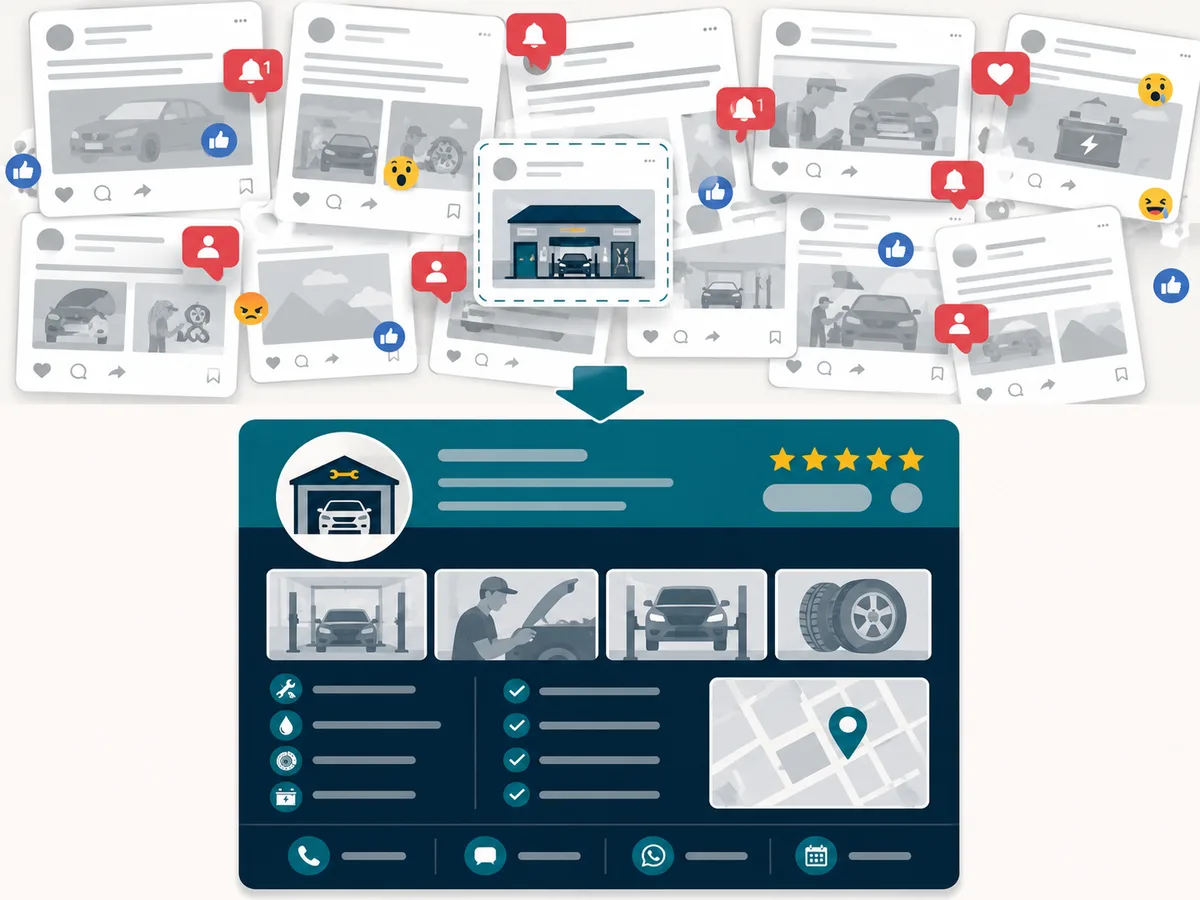

You've got a Facebook page. You've got WhatsApp. Business comes in from regulars and word of mouth. So when someone says "you need a website, boss," it's fair to be sceptical — that sounds expensive, complicated, and like a job for somebody with more free time than you have.
Here's the honest version of the answer.
Key takeaway
Most of your potential customers now check you online before they call or WhatsApp you. That part is no longer optional — it happens whether you participate or not. So the real question isn't "do I need a website?" It's this: when someone searches your workshop's name tonight, does what they find convince them to message you — or the shop down the road?
The good news: fixing this doesn't require a RM5,000 website. But it does require more than a Facebook page. Let's walk through why.
How Malaysian customers actually pick a workshop in 2026
Think about how you found the last restaurant you tried, or the aircond guy for your house. Workshop customers behave the same way, and the pattern tends to look like this:
- Search. They Google "workshop near me", "gearbox specialist [area]", or — very commonly — they get your name from a friend or a Facebook group, and then they Google that name to check you out.
- Compare. They open two or three options side by side. They're scanning for the basics: What services do you do? What do your premises and work look like? Roughly what will it cost? What do other customers say?
- WhatsApp. They message the one or two shops that looked most convincing. Only now does your famous personal touch get a chance to work.
Notice something: each step filters workshops out. If you don't appear in the search, you were never in the race. If they find you but see a page that answers none of their questions, they quietly move on — you'll never know that customer existed. Many workshop owners assume business is slow because of the economy, when actually they're being filtered out at step one or two every single day.
If you want the full picture of where to show up, we covered the free channels in 7 free ways to promote your workshop online. This article is about the layer underneath: what customers find when they check you.
What Facebook does well — and its 3 hard limits
Let's be fair to Facebook first, because "delete your page" would be terrible advice. Facebook is genuinely good at:
- Staying visible to people who already follow you
- Sharing photos of finished jobs and workshop life
- Community groups, where a helpful comment can win a real customer
Keep your page. Keep posting. But understand what it structurally cannot do for you.
Limit 1: Your posts sink in 48 hours
That great before/after post about the Myvi gearbox rebuild? Two days later it's buried under everything else in the feed. A customer who lands on your page next month doesn't see your best work — they see whatever you happened to post last, which might be a Raya greeting or a "closed for holiday" notice. On Facebook, your reputation resets constantly. You're only as impressive as your latest post.
Limit 2: You don't control it
Your page lives on rented land. Facebook decides how many of your own followers see each post — and organic reach has been shrinking for years, which is exactly why the "Boost Post" button exists. Facebook can change the rules, restrict your page, or lock your account, and there is no customer service hotline to call when it happens. Ask any business owner who's been through an account hack or a mysterious restriction: recovering can take weeks — and sometimes the page never comes back. Everything you built there belongs to the platform, not to you.
Limit 3: It can't answer "what do you offer, at what price?"
This is the big one. A Facebook page is a feed, not a menu. A customer arriving with the two questions that matter most — what services do you do and roughly what does it cost — has to scroll through months of posts hoping to piece it together, or message you and wait. Most won't bother. And the ones who do message end up asking you the same questions on WhatsApp, one at a time, every day, forever. You've probably typed "yes boss, we do aircond service, from RM..." more times than you can count. That's not marketing. That's you manually doing the job a proper online presence does automatically.
What a permanent online presence actually changes
A permanent presence — whether that's a full website or a structured business profile — flips all three limits:
- One stable link. Your services, photos, price ranges, location, opening hours, and reviews live at a single address that doesn't sink, expire, or get buried. Today's visitor and next year's visitor see the same complete picture.
- It answers questions before they're asked. The customer arrives, sees what you do and roughly what it costs, sees proof of your work, and moves straight to "can you take my car Thursday?" You skip the twenty-questions stage entirely.
- Search engines can actually find it. Google largely can't index the inside of your Facebook feed, but it can index a real page. When someone in your area searches for what you do, a structured page has a fighting chance of appearing. A two-year-old post doesn't.
- It makes everything else work harder. Your Facebook posts, group comments, and WhatsApp replies all get one link to point at. Facebook becomes your loudspeaker; the presence becomes your shop front. They're teammates, not rivals.
The honest options table
Here's the comparison nobody selling you something will show you. Costs are estimates as of July 2026 and vary by provider.
| Full custom website | Facebook page only | Business profile platform (e.g. CarJom Studio) | |
|---|---|---|---|
| Cost | RM2,000–8,000 to build, plus RM300–800/yr hosting & domain (est., Jul 2026) | Free | Free to start (est., Jul 2026) |
| Effort | Weeks of back-and-forth with a developer; ongoing updates need help or learning | Low to start, but constant posting needed to stay visible | Roughly 15 minutes to set up; update it yourself like a Facebook post |
| Control | Total — your domain, your design, your rules | Low — platform owns reach, rules, and your account | High for content; the platform handles the technical side |
| Findability on Google | Excellent if built properly and maintained — many cheap builds never rank | Weak — posts aren't built to answer search queries | Good — structured pages designed to be indexed and found |
The honest read of this table:
- A full custom website is genuinely the right choice for some businesses: multi-branch operations, workshops needing online booking systems or e-commerce, or established brands with the budget and someone whose job includes maintaining it. If that's you, invest properly — a good site is an asset. (We'll do a deep-dive comparison soon: website vs Facebook — the full breakdown , and later a profile platform vs building your own website .)
- Facebook-only is fine if you're genuinely full from repeat customers and have no intention of growing. No shame in that.
- The profile platform is the middle path: most of the benefit of a website, near-zero cost and effort, in exchange for less customisation. For a typical one-outlet workshop, that trade is usually the sensible one.
What "good" looks like
Whichever option you choose, a presence that converts has the same anatomy: your name and area stated clearly, a real list of services (with price ranges where you can), eight to ten genuine photos of your shop and your work — not stock images — customer reviews, accurate opening hours, and a WhatsApp button that works on the first tap. We'll break down the full anatomy in the 9 details customers look for before choosing a workshop .
The bar is honestly not high. Most of your competitors haven't done this either. That's precisely the opportunity.
FAQ
Should I keep my Facebook page if I set up a proper online presence? Yes, absolutely. They do different jobs. Facebook keeps you visible and active; your permanent presence closes the deal when someone checks you out. Post on Facebook, link every post back to your profile, and let each do what it's good at.
What does an online presence actually cost? As of July 2026 (estimates): a custom website typically runs RM2,000–8,000 to build plus RM300–800 a year for hosting and domain. A Facebook page is free. A business profile like CarJom Studio is free to start. Match the tool to your size — don't pay RM6,000 to solve a RM0 problem, and don't stay invisible to save money you weren't spending anyway.
I barely have time to eat lunch. How long does this really take? The basics — services, photos from your phone, hours, WhatsApp contact — take about 15 minutes on a profile platform. Do it while waiting for a paint job to dry. A custom website is a multi-week project; save that for when the business case is clear.
Your workshop already has a reputation. Give it an address. Create your workshop's permanent online home — CarJom Studio, free to start, live before lunch.
Ready to put your business online?
Create a CarJom Studio to display your services, products, location, and contact details in one shareable link. Free to start, no technical skills needed.