
Every workshop in Malaysia will tell you the same thing: "We're honest here, boss." And yet almost every driver has a story — the RM200 job that somehow became RM800, the "urgent" part that probably wasn't, the invoice you couldn't question because the work was already done. If you've been burned before, searching for a reliable car workshop near me and hoping for the best doesn't feel like enough. The good news: you don't have to rely on hope. Trust leaves evidence, and you can check for it before a single ringgit changes hands.
Key takeaway: A trustworthy workshop is checkable, not a gamble. Run these 10 signals — reviews, written quotations, old parts shown, specialisation, transparent rates, warranty, workshop condition, the questions they ask, no scare-selling, and after-job contactability — before you hand over your keys. If a workshop fails the big ones, walk away, no matter how friendly the foreman is.
Not sure your car even needs a workshop visit yet? Check what's actually due at your mileage in our car service schedule guide first.
The 10-point checklist for choosing a car workshop
1. Reviews — and how the workshop replies to them
Anyone can collect five-star reviews from friends and family. What you're really reading for is how the workshop behaves when things go wrong. Look at the 2- and 3-star reviews and check whether the owner replies — calmly, specifically, and with an offer to fix the problem.
Pass: A 2-star review about a delayed repair gets a reply naming the job, explaining what happened, and inviting the customer back. Fail: Bad reviews are ignored entirely, or the owner argues with customers in the replies. A workshop that fights reviewers in public will fight you in person.
2. Itemised written quotations — always
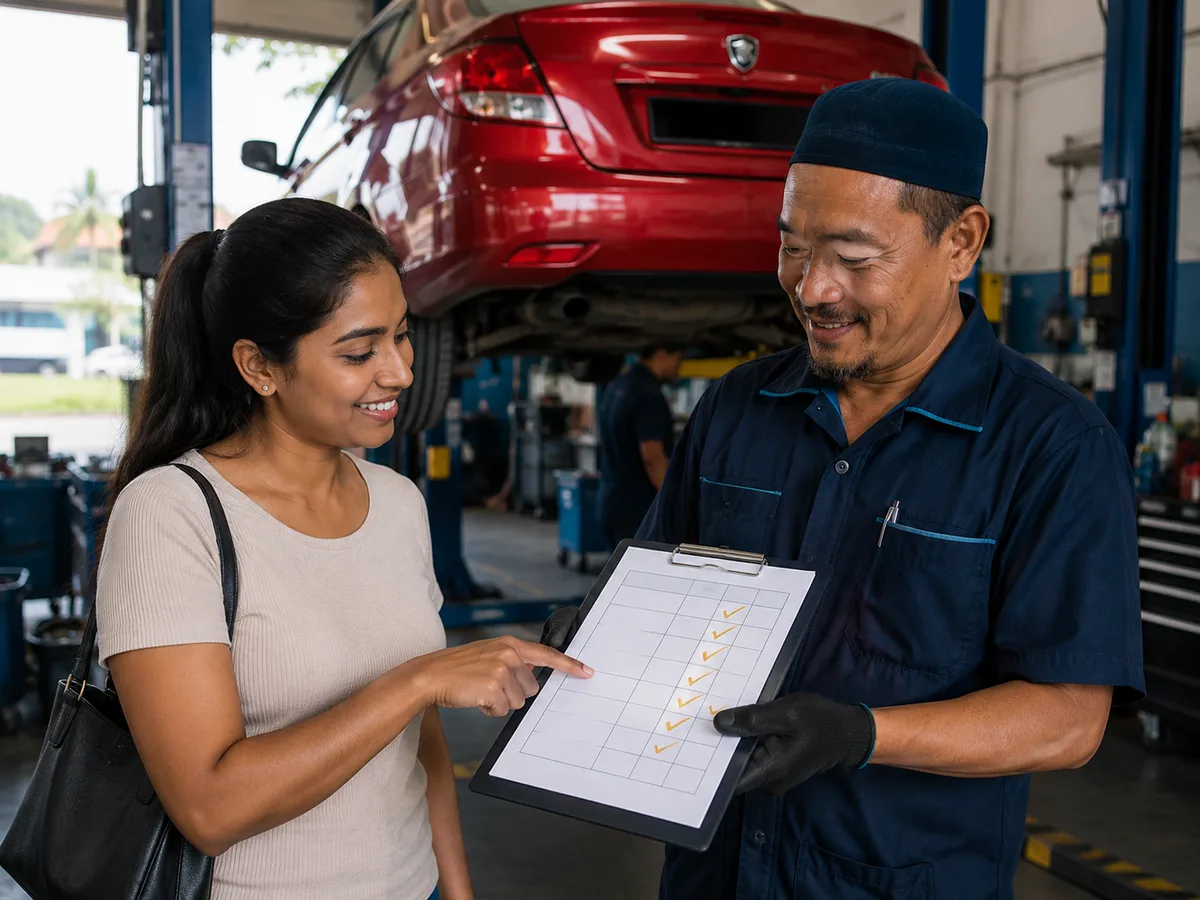
A reliable workshop puts the price in writing before starting: parts listed by name, labour as its own line, and a total. Verbal estimates like "around three, four hundred lah" are how RM400 becomes RM900.
Pass: You get a WhatsApp message or printed quote listing "front brake pads (brand X) — RM180, labour — RM60" before any work begins. Fail: "Open up first, then we see" — with no written figure at any point. If they won't commit to a number before the job, they won't defend one after it. We'll break down how to read a workshop quotation line by line in an upcoming guide.
3. They show you the old parts
This is the single cheapest honesty test in the industry. A workshop that replaces your brake pads, battery, or absorbers should show you the worn part — ideally next to the new one — without being asked.
Pass: The foreman calls you over: "See, boss, pad tinggal 2mm already." You can see the wear with your own eyes. Fail: "Already thrown away" ten minutes after the job finished. If the old part conveniently vanishes every time, you have no proof the part was ever bad — or ever replaced.
4. Specialisation matches your car
A workshop that services Perodua and Proton all day may be excellent — for Perodua and Proton. Continental cars, hybrids, and EVs need different diagnostic tools, parts channels, and experience. Ask directly: "How often do you work on this model?"
Pass: "We do a lot of Hondas — we keep the common filters and pads in stock." Fail: A vague "all cars can do" while your BMW would be the first one they've seen this year. Confidence is not competence.
5. Transparent labour rates
Parts prices are easy to verify online; labour is where quiet padding happens. A good workshop can tell you its labour charge for a given job — per hour or per task — before you commit, and the number doesn't mysteriously change between quote and invoice.
Pass: "Labour for absorber replacement is RM80 per side, fixed." Fail: Labour appears on the invoice as one round, unexplained number that's suspiciously close to the cost of the parts themselves.
6. Warranty on their work
"Trust me, boss" is not a warranty. Reliable workshops stand behind both parts and workmanship for a stated period — commonly one to six months on labour, plus whatever the part manufacturer offers — and they'll say so before you ask.
Pass: "Parts follow manufacturer warranty; our workmanship, three months — if the same problem comes back, bring the car in." Fail: Any version of "no such thing as warranty for repair, bro." That's a workshop planning to never see you again.
7. Clean-enough, organised bays
Nobody expects a hospital. Workshops are oily places. But there's a difference between working mess and chaos: tools scattered on the floor, cars stacked with no visible system, fluids pooling everywhere. Organisation in the bay usually mirrors organisation in the paperwork — and in the work itself.
Pass: Tools on trolleys or boards, parts labelled per car, walkways clear. Fail: Your car keys tossed into a drawer with fifteen others and no tag, next to an ashtray.
8. They ask questions before quoting
A mechanic who quotes instantly is guessing — and pricing in room for the guess. A good one interrogates the symptom first: When does the noise happen? Cold start or after driving? Which side? Any recent work done?
Pass: Five minutes of questions, maybe a short test drive, then a diagnosis and a price. Fail: You say "got sound when braking" and hear "brake pump problem, RM600" before you've finished the sentence.
9. No scare-selling
You came in for an oil change and suddenly your car is "very dangerous to drive" without RM1,500 of extra work. Real problems can be shown: a cracked belt you can see, a leak you can touch, a reading on a gauge. Fear with no evidence is a sales technique, not a diagnosis.
Pass: "Your tyres still okay for now — maybe another 10,000 km, check again next service." Advice that delays spending is the strongest honesty signal there is. Fail: Every single visit uncovers a new "urgent" problem, and the urgency evaporates when you ask them to show you.
10. Reachable after the job
Anyone is friendly before payment. The test is afterwards. Does the workshop answer your WhatsApp two days later when the noise comes back? A reliable workshop treats the after-job question as part of the job.
Pass: You message about a squeak after a brake job and get "bring it in tomorrow, we'll check — no charge if it's our work." Fail: Read receipt, no reply — the same number that replied within minutes when you were asking for a booking.
Red flags that outweigh everything
The checklist above is about weighing signals. These three are different — any one of them is a walk-away trigger on its own:
- The quote jumps after work starts. "Boss, opened up already, found more problems" — and the price doubles while your car sits in pieces, unmovable. A genuine discovery comes with a photo, an explanation, and your approval before proceeding. A price ambush comes with pressure.
- They refuse to show you the old part. Not "forgot" — refuse. There is no innocent reason. The part is your property and your proof.
- Cash only, no receipt. No paper trail means no warranty claim, no dispute, no evidence the work was ever done. If a workshop's payment process is designed to be untraceable, assume the rest of the business is too.
If you hit any of these mid-job, pay for what's genuinely done, take your car, and don't return. The few hundred ringgit you might lose today is cheaper than what this workshop will cost you over the years.
Where to look for a reliable workshop near you
Start with three sources and cross-check them against the checklist:
- Google. Search "car workshop near me" or your area name, then read reviews the smart way — sort by lowest, read the replies (point #1).
- Word of mouth, upgraded. Ask in communities that know your car: your model's owner Facebook group, your Telegram car club, your apartment or office group. "Anyone got a trusted workshop for Myvi around Kepong?" gets you answers with skin in the game — these people have to face you again if the recommendation is bad.
- Compare workshop profiles side by side. On CarJom you can view workshops near you with their services, photos, and reviews in one place — which makes checklist points #1, #4, and #7 checkable from your sofa before you visit anyone.
Shortlist two or three. Never arrive at a workshop with zero alternatives — desperation is expensive.
First-visit strategy: start with a small job
Don't hand a new workshop your gearbox. Test them with something small and low-stakes: an oil change, tyre rotation, or aircond gas top-up. A small job lets you observe most of the checklist live — do they quote in writing, show the old oil filter, invoice what they quoted, and reply to a follow-up message? If a workshop is careless or pushy on a RM150 job, you've learned everything you need for RM150 instead of RM3,000. If they pass, you've found something genuinely valuable: a workshop you can trust before the big repair, not during it.
FAQ
Dealer service centre or independent workshop — which is more reliable?
Neither is automatically more honest. Dealer service centres offer standardised pricing, brand-trained mechanics, and stamped service records (which matter for warranty and resale) — at higher labour rates. Good independents are cheaper and often more flexible, but quality varies wildly, which is exactly why this checklist exists. A common pattern in Malaysia: dealer during the warranty period, then a vetted independent after.
Is the cheapest quote always a trap?
Not always — but a quote far below everyone else's usually has a reason: lower-grade or non-genuine parts, rushed labour, or a lowball that grows once your car is opened up. Compare quotes on scope, not just the total: same part brand? Labour included? Warranty stated? We'll publish a full guide to comparing workshop quotes properly.
What should I ask on the phone before visiting?
Four questions filter most bad workshops in two minutes: (1) "Do you often work on my model?" (2) "Can you give a written quotation before starting?" (3) "Do you give warranty on workmanship?" (4) "Can I see the old parts after replacement?" Hesitation on any of these tells you plenty.
Specialist or general workshop?
For routine servicing and common wear items, a good general workshop is fine and usually cheaper. For gearbox, aircond, hybrid systems, or continental cars, a specialist's experience typically saves money overall — fewer misdiagnoses, fewer repeat visits. Match the workshop to the job, not to habit.