
Your car battery almost never dies without warning — it drops hints for weeks before it finally gives up in a mall carpark or outside your house on a Monday morning. The problem is that most Malaysian drivers don't recognise the hints until the car refuses to start. This guide walks through the 10 most common weak car battery signs, how to test your battery for free, and what to do if it's already too late.
Key takeaway: In Malaysian heat, a car battery typically lasts only 1.5 to 2 years — not the 3 to 4 years often quoted overseas. The single most reliable early warning is slow cranking: the engine turns over sluggishly before it catches, especially on the first start of the morning.
The 10 signs your car battery is dying
1. Slow cranking — the engine hesitates before starting
This is the classic sign, and usually the first. When you turn the key or press the start button, the engine cranks slower than usual — a laboured rurr… rurr… rurr instead of a quick, confident start. A healthy battery spins the starter motor briskly. A weak one struggles, and the struggle is most obvious in the morning after the car has sat overnight. If your car is hard to start in the morning but fine after driving, your battery is telling you something.
2. Dim headlights or cabin lights at idle
Notice your headlights dimming at a traffic light, then brightening when you rev the engine? At idle, a weak battery can't hold the electrical load, so lights and interior displays go noticeably dimmer. If your dashboard glow or headlight beam changes with engine speed, put the battery on your suspect list.
3. Battery warning light on the dashboard
The little red battery icon doesn't always mean the battery itself is faulty — it signals a charging-system problem, which could be the battery, the alternator, or the wiring. Either way, don't ignore it. Get the charging system tested the same week; most battery shops will check it for free.
4. Electronics acting strange
Power windows crawling up slower than usual, the radio resetting itself, the infotainment screen rebooting, central locking behaving erratically — modern cars are packed with electronics, and they're often the first victims of an unstable voltage supply. Random electrical gremlins across several systems at once frequently trace back to one tired battery.
5. You've needed a jump start recently — more than once
One jump start after leaving your headlights on overnight is forgivable. Needing a jump start twice in a few weeks with no obvious cause is not — it means the battery can no longer hold a proper charge. Each deep discharge also damages the battery further, so don't keep jump-starting and hoping. Plan the replacement.
6. Swollen or bloated battery case
Open the bonnet and look at the battery's sides and top. A healthy case has flat, straight walls. Heat — and Malaysia has plenty — can cause the internal chemistry to release gas and swell the casing outward. A bloated battery is beyond saving and can be a safety hazard. Replace it promptly.
7. Corrosion on the terminals
White, green or bluish powdery crust around the battery terminals is corrosion from leaking gas or fluid. Light corrosion can be cleaned off, but heavy, recurring build-up interferes with charging and usually signals a battery nearing the end of its life. If you're wiping the terminals every month, the real fix is a new battery.
8. A rotten-egg smell near the battery
A sulphuric, rotten-egg smell under the bonnet means the battery is leaking or overcharging and venting gas. This one is not a "monitor and see" sign — the leaking acid can damage surrounding components. Have it inspected as soon as possible, and avoid touching any leaked fluid.
9. The battery is more than 1.5 years old
Age alone is a warning sign here. Most batteries sold in Malaysia carry a manufacture date sticker or stamped code — check it. Past the 1.5-year mark in our climate, the battery is living on borrowed time even if it still starts the car fine today. From that point on, a free battery health test every few months is cheap insurance.
10. Repeated dead mornings
The end-stage pattern: the car starts fine all day while you're driving, but after sitting overnight the battery is flat again. That means it can no longer hold charge while resting. Once you're on your second or third dead morning in a row, the battery is finished — no amount of charging will bring it back reliably.
Why Malaysian weather is brutal on car batteries
Battery lifespan figures you read online — "3 to 5 years" — mostly come from temperate countries. Malaysia is a different story:
- Constant heat. Under-bonnet temperatures here routinely exceed 60°C in traffic. Heat accelerates the chemical reactions inside the battery, which speeds up internal corrosion and evaporates electrolyte. Heat, not cold, is the number one battery killer.
- Short trips and traffic jams. Stop-start city driving means the alternator never gets a long enough run to fully recharge the battery, so it lives permanently undercharged.
- Aircond always on. In Malaysia, the aircond runs from the moment you start the car. Together with headlights, dashcam and phone chargers, the electrical load at idle is high — and at idle, a marginal battery gets little help from the alternator.
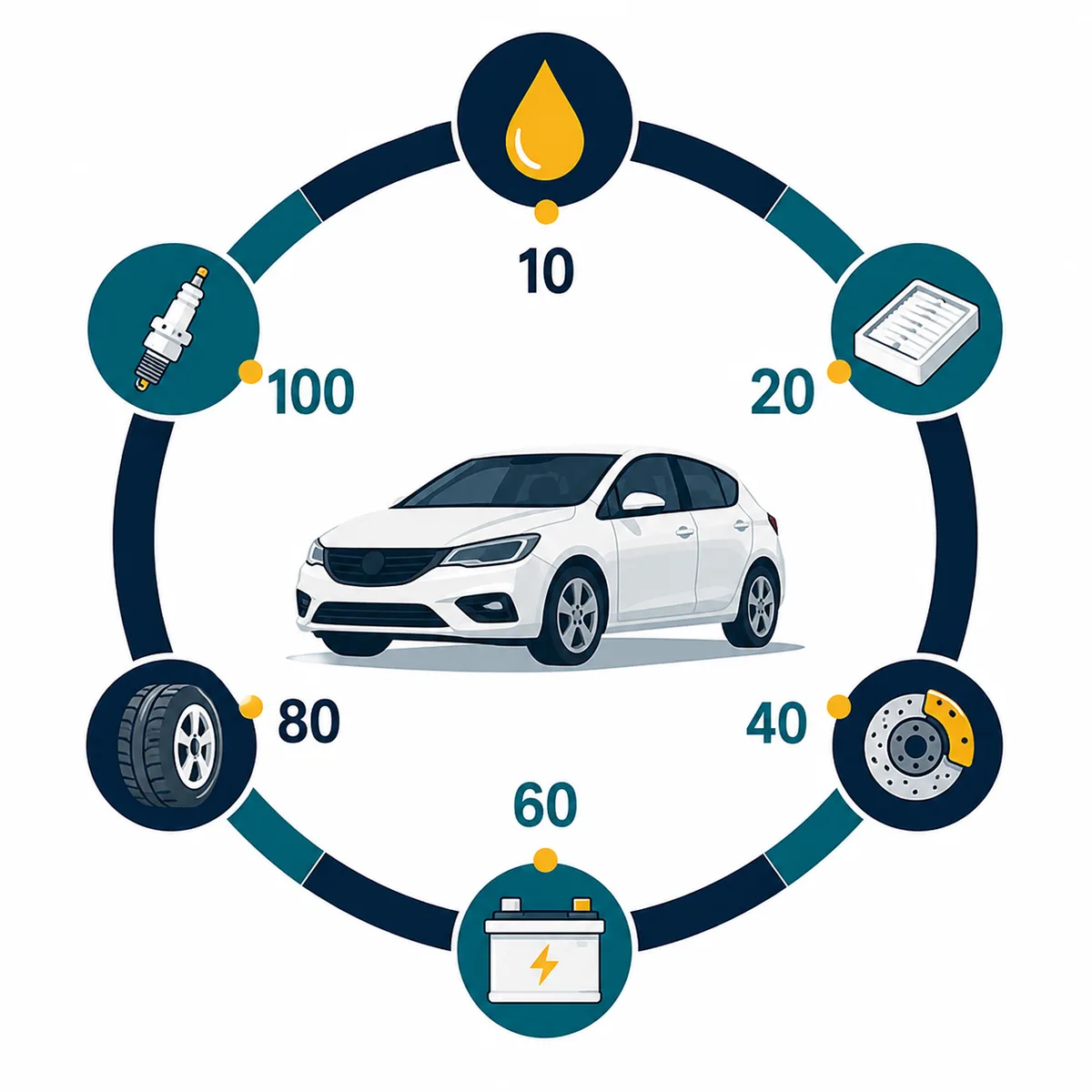
Put those together and the realistic lifespan of a car battery in Malaysia is about 1.5 to 2 years. If yours is older and showing any sign above, replacement is a matter of when, not if. Battery checks are also part of routine maintenance — see our complete car service schedule for Malaysia for what else runs on its own clock.
Test before you replace: free checks and the voltage table
Don't replace a battery on suspicion alone. Two easy options:
- Free battery test. Most battery shops and many workshops in Malaysia will test your battery and charging system free of charge with a proper battery analyser. It takes five minutes and tells you the battery's actual health, not just its voltage.
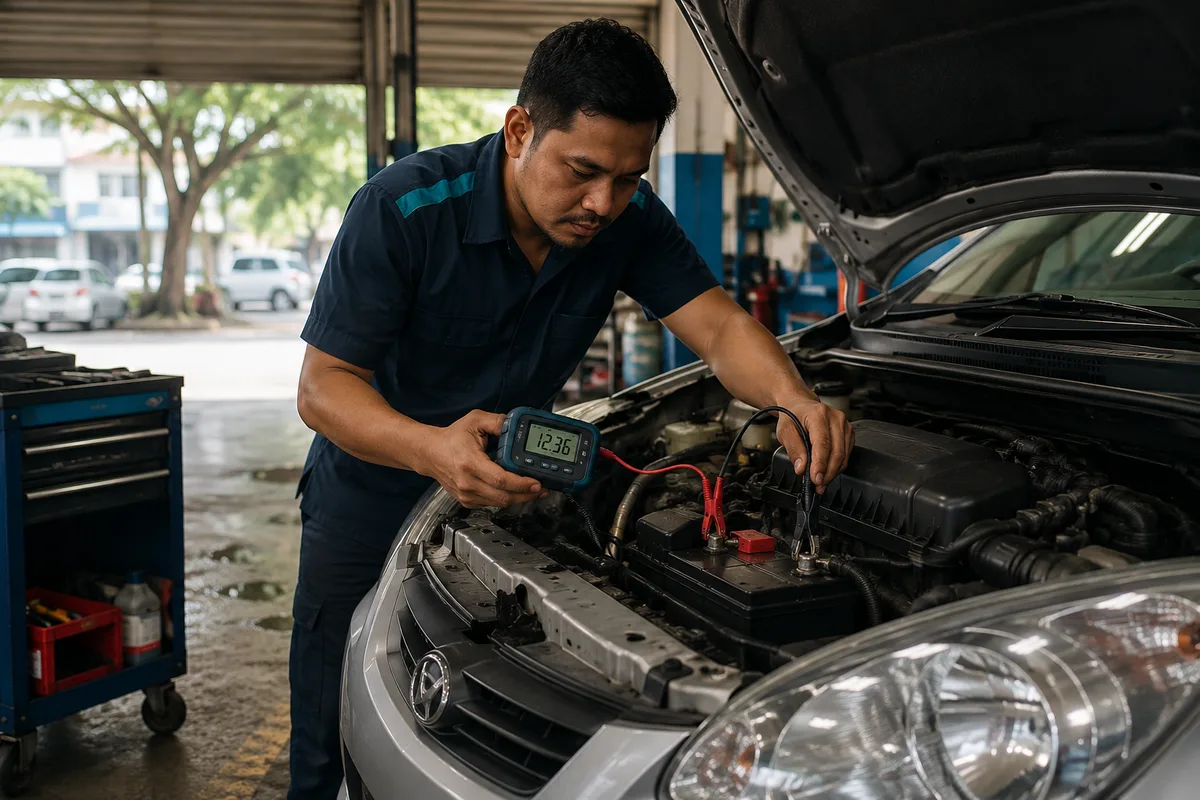
- DIY multimeter check. If you have a basic multimeter, measure across the terminals with the engine off and the car rested (ideally overnight, or at least a few hours after driving):
| Voltage (engine off, rested) | What it means |
|---|---|
| 12.6V or higher | Healthy, fully charged |
| Around 12.4V | Roughly half charged — recharge and retest |
| 12.0V or below | Deeply discharged or failing — get it tested professionally |
A battery that reads 12.6V can still fail under load, which is why the shop's analyser test is the more reliable verdict. But if your rested battery keeps sagging to 12.0V, the writing is on the wall.
Battery already dead? Your two realistic options
Jump start. If you have jumper cables and a willing neighbour, a jump start can get you moving — but connection order and polarity matter, and mistakes can damage your car's electronics or injure you. We'll cover the full step-by-step safely in a dedicated guide. If you're not confident, don't experiment: call a professional. Hybrid and EV owners should always consult a professional — their 12V systems have specific procedures.
Mobile battery replacement. Often the smarter option: a mobile battery service comes to your location, tests the battery, and replaces it on the spot — usually within the hour in the Klang Valley. No towing, no pushing the car, no second dead morning. We're publishing a full guide to mobile battery services in KL and Selangor soon.
As of July 2026, a typical car battery in Malaysia costs roughly RM150–450 installed, depending on battery size and brand (estimates only — a detailed price guide is coming).
FAQ
How do I know if it's the battery or the alternator?
Rough rule of thumb: if the car starts fine after a jump but dies again after sitting, suspect the battery; if it dies while driving or the battery light stays on with the engine running, suspect the alternator. The only certain answer is a charging-system test — and we're publishing a full battery-vs-alternator diagnosis guide.
How much does a car battery cost in Malaysia?
As of July 2026, expect roughly RM150–450 installed for most passenger cars, depending on size (NS40, NS60, DIN types) and brand. Mobile installation may add a small fee. Full price breakdown by battery size coming soon.
Does using the aircond drain the battery?
While driving, no — the alternator carries the load. The risk is using aircond, lights or accessories with the engine off, or long periods idling with a weak battery. If your battery is healthy, normal aircond use won't kill it; if it's marginal, heavy idle loads accelerate the end.
Can a dead battery recover?
Sometimes, partially. A battery flattened by a dome light left on can often be recharged and carry on if it's young and healthy. But a battery that dies repeatedly, is swollen, or is past 1.5–2 years old in Malaysian conditions won't recover meaningfully — recharging it just delays the inevitable breakdown, usually at the worst possible time.
Don't wait for the tow truck
If you've recognised two or three of these signs in your own car, get the battery tested this week — it's free, and it beats being stranded at 7am with a full day ahead.